The Process of “Defining the World”Experiencing the emerging form and determining the world the photobook will contain
「世界を見定める」行程できあがりの姿を実感し、写真集に宿る世界を見定める行程

From here, editor and designer work together to give the project a form, however provisional. If the author had extensive experience making photobooks, it might be possible to begin with a fully developed design. Here, what matters is first making the book tangible, even while some details remain unresolved. This is the prototype from which the work will be refined. “Defining the world” may sound grand, but some things become visible only when we move our hands and commit ourselves, rather than merely thinking. We look at the prototype and determine what kind of world resides within it.
さて、ここからは編集者とデザイナーがタッグを組み「ともかく形にしてみる」行程です。著者が写真集制作の経験が豊富にあれば、いきなり作り込むことも考えられます。まずは詰めが甘くとも形にして、写真集の姿が見えてくることが大事。そんな訳の「試作」です。ここから磨き上げていくための行程です。世界を見定めるとは大袈裟に聞こえるかもしれませんが、人は頭で考えるだけではなく、手を動かして力を注いでこそ見えてくるものがあると思うのです。その「試作」を見て、そこにどんな世界が宿るのかを見定めます。
⑥ Review and Brainstorming
⑥レビュー&ブレスト
Using Scott's rough layout as a starting point, we exchanged a wide range of ideas. No matter how carefully an author imagines the reader while working, the editor is quite literally another person and offers a candid response. The clear difference between their positions is important. The editor must receive the author's intentions and reflect them in the photobook as fully as possible, but must also consider how they will reach the reader. A presentation that creates confusion needs to be untangled. If it is difficult, the editor asks whether that difficulty has meaning; if it would be better for the material to communicate smoothly, the editor establishes a way to accomplish that. The key to this stage is for author and editor to speak as fully as possible.
Scott氏が作成したラフレイアウトを元に、様々な意見交換をします。著者がいかに読み手のことを思い浮かべて作業をしたとしても、編集者は間違いなく物理的にも他人であり、その意見を率直に投げかけます。ここで大事なポイントは、著者と編集者のあからさまな立場の違いです。編集者は著者の想いを受け止め、写真集にそれをできる限り投影することも大事なのですが、読み手にいかに伝えられるかを考えます。混乱を招くような体裁は、それをほどく必要があり、難解であれば難解である意義を考え・問い、スムーズに伝わることのほうが望ましければ、その方法論を考え打ち立てます。この行程のポイントは、できるかぎり言葉を尽くして著者と会話することです。
⑦ Establishing the Basic Editorial Policy
⑦編集基本方針の設定
For the work to become a single book, its story should flow as smoothly as possible, with a consistent tone and manner that avoids needless confusion. This photobook, for example, contains both color and monochrome photographs, so the pagination also had to be planned carefully. The page structure sometimes required us to add newly selected photographs or remove others. Considering the central idea we wanted to convey could lead us to ask for another image, or to cut one instead. The editor on this project is also a photographer. Many requests were painful to make, but the responsibility was to serve fully as an editor. In this way, we gradually drew toward us the thread leading to completion.
一冊の本とするならば、ストーリーができるかぎり淀みなく流れ、読み手に無用な混乱を招かないトーン&マナーを念頭におくことになります。たとえば、今回の写真集はカラーやモノクロームのカットが混在する内容であり、台割り(ページの割り振り)も混乱を招かないように配慮する必要がありました。台割りの関係上、カットをあらたにセレクトして差し込んだり、削ったりする必要も出てきます。また、伝えたい内容の”芯”を考えれば、もう少し他のカットが差し込めないか、逆にカットを削ったり。今回編集を担当したスタッフも1人の撮り手。心の痛いお願いも多々でてきますが、編集者という立ち位置で職務を全うします。こうして、完成に至るまでの天から伸びる”ツル”を少しずつ手繰り寄せていきます。
⑧ Preliminary Design
⑧仮デザイン
Once author and editor agreed on the content and the pagination was fixed, the work passed to the designer. The author and editor first assembled the elements that would constitute the world; the designer then made them concrete and visible. The designer worked with everything in mind, from the binding to the way the book would appear on a shelf. At this stage, the project began to feel much more real. Its destination also became clear, prompting us to look back at its original point of departure: the vision itself.
内容のコンセンサスが著者と編集者の間で取れて、台割りが確定すれば、デザイナーにここでバトンタッチします。著者と編集者が「世界を構成する要素」を一旦作り上げ、それをデザイナーが「具象化・具現化」する。そんなイメージです。装丁や、果ては書棚に並ぶところまでを想定してデザイナーはデザインします。この行程に辿り着くと、ぐっと実感を伴ってきます。そして取り組みの着地点が明確に見えてくるため、そもそもの「想い」という起点を見返すことにも繋がります。
⑨ Review and Brainstorming
⑨レビュー&ブレスト
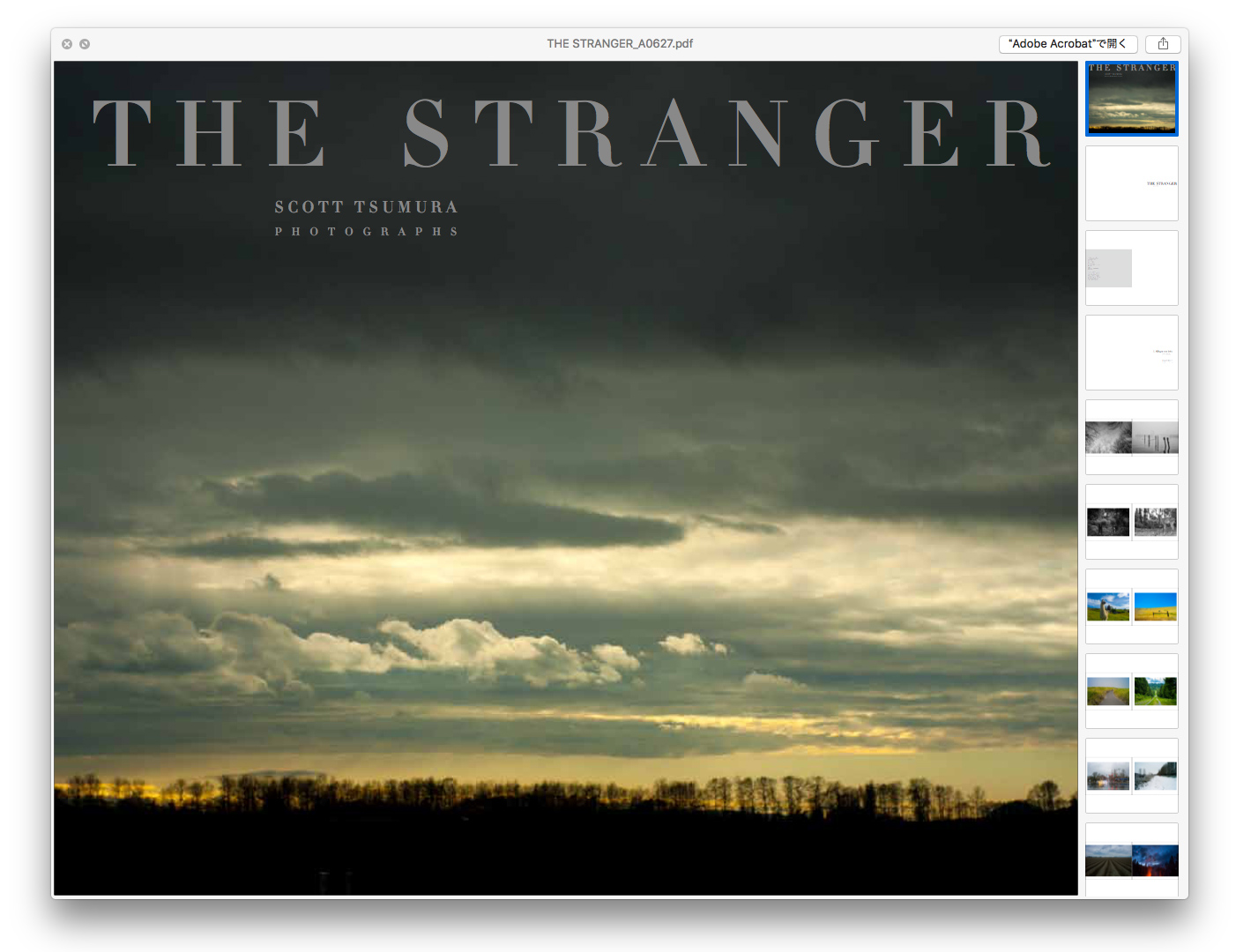
Unlike the rough layout the author made alone, the completed prototype now contained the work of another person. Because the finished photobook was beginning to take shape, it could be viewed as a physical book. The author and editor therefore exchanged ideas once more. At this stage, we had performed only the basic editing needed to give it the form of a book, following the author's rough layout as closely as possible. In this project, that review led to a major change in the core concept and the structure built around it: we changed the title of the photobook.
できあがった「試作」は、著者が1人で作り上げたラフレイアウトとは違い、他人の手が介在したものです。そして写真集としての仕上がりが見えてくるため、一冊の本として形を伴って見つめることができます。そこで、著者と編集者がもう一度ここで意見交換を行います。実は、この段階では本として体裁を整える基本的な編集だけを行い、できる限り著者の作成したラフレイアウトに沿って「試作」しています。今回の場合、この行程で基本コンセプトとそれに伴った構成内容に大きな変更を受けました。写真集のタイトルを変更したのです。
Why the Title Changed from Stranger to With the Wind: What the Process Revealed
Stranger から With the Wind にタイトル変更した理由 - 取り組んでみてわかること -
Following my interests, pursuing whatever drew my heart, and letting myself be guided by the current rather than resisting it, I devoted myself to many kinds of work. Each time, I became someone from somewhere else. Given that history, the editorial team proposed “Stranger” as a title and theme. It made sense to me, and the people around me thought it sounded interesting. I tried various selections and sequences based on that idea. I sent them to the editors several times, but they never quite gave their approval. Part of the problem, I think, was a difference between what they were looking for and the image I had in mind. I also felt that building a theme around a summary of my own life might be presumptuous. The work reached an impasse. I no longer knew which photographs to choose or how to arrange them. Around then, the editors suggested again, “Let's continue in the spirit of the series.” Making a photobook was unknown territory for me, so naturally I had braced myself. I imagine the editors, thinking “if we are going to make one...,” had done the same. In the end, that allowed us to arrive at a theme and title connected simply to the pleasure of photography that I had enjoyed all along. (Scott)
興味のまま、心惹かれるままに、そして流れに逆らわず導かれるままに、様々な仕事に打ち込んできました。そして何時も何処かの誰かとなる。そんな私の経緯から「Stranger」というタイトルとテーマはどうだろうと、編集部の方から提案していただきました。なるほどと思い、周囲に話してみても「面白いんじゃないか」と。そして、それに沿ったセレクトや並びをいろいろと行ってみました。幾度か編集部に投げてみるものの、なかなか首を縦に振ってくれない。編集部から求められているものと、私の持つイメージが食い違っていたという面もあったと思います。そもそも自分の半生をまとめるようなテーマで作り込むなんてことが、おこがましいのではないかという気持ちもありました。そして作業は膠着状態に。写真を選ぶことも並べることも、何をどうすればよいのかわからなくなりました。そんな頃「連載の時の延長で行きましょう」と再び提案をいただきました。写真集を作るなんてことは、私にとって未知なる作業でした。だからこそ構えた面もあります。そして編集部の方も「作るのならば・・」と、やはり構えていただいたことだろうと思います。したがって結果的に、これまで楽しんできた写真の面白さに、シンプルに紐付くようなテーマとタイトルに辿り着くことができました。( Scott氏 )
by Yodobashi Camera