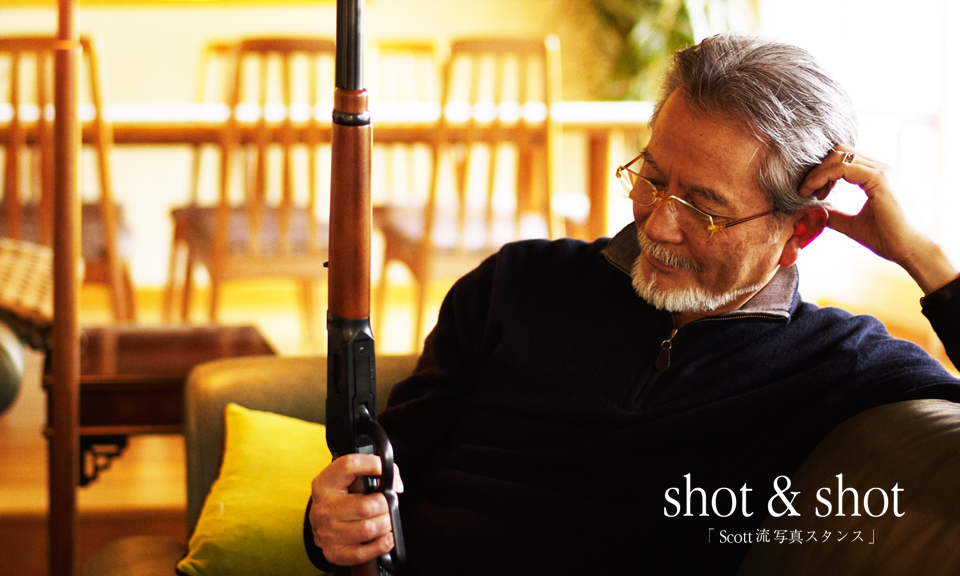

The title of Mr. Scott’s blog is “shot & shot.” He’s a former rifle shooter with a wonderful record (ranked 2nd in Osaka prefecture, 13th in the nation * National Rifle Association of Japan) and he named his blog because he associates firing the camera’s shutter with pulling the rifle’s trigger.
He explains the reasons he associates photo shooting with rifle shooting:
- Rifle shooting: aim the rifle, make sure it’s pin-pointing the target, and shoot.
- Photo shooting: quickly frame and fire the shutter.
Scottさんが運営するblogのタイトルは「shot & shot」。素晴らしい戦績をお持ちの元ライフル射撃の選手であり(大阪府2位/全日本13位※ライフル射撃競技会)、ライフルのトリガーを引くこと、そしてカメラのシャッターを切ることが感覚的にオーバーラップすることから名付けられたそうだ。
Scottさんがライフル射撃と写真撮影を重ねる理由を説明してくれた。
- ライフル射撃:標的に銃を向け、確実に狙いトリガーを引き、撃つ。
- 写真撮影:素早く枠に切りボタンを押し、撮る。
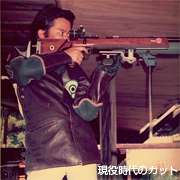
He says these two actions are similar in terms of “timing of breathing.” I was amazed by the fact that he pulls the trigger between the heartbeats when he shoots a rifle. The average pulse rate of adult men is about 60–70 per minute. I can only guess, but while a shooter keeps pulling the trigger between the heartbeats every about 1 second, s/he must be in a state where tension and tranquility coexist.
In other words, it’s an action of cutting time up into pieces, or of feeling infinite time. Imagine. In a certain period of time in between 1 to 4 hours, a shooter shoots through the center of the target (whose diameter is 1cm for 50m away and 10cm for 300m away) without fail. Only the shooter’s heartbeat echoes and there’s no other sound. When the heart starts to beat faster, it becomes even faster. In such a tension, the shooter may lose the right timing. And, he says that’s not good.
この2つの行為、何よりそれぞれの「呼吸の間合い」と言うべきものが似ていると感じるそうだ。伺って面白いなと感じたのがライフルを撃つときに、心臓の鼓動と鼓動の狭間でトリガーを引くということ。成人男性の脈拍が約60-70/分。おおよそ1秒間隔で脈打つ鼓動の狭間にトリガーを黙々と引いていくことは、想像の域を出ないが緊迫と静寂が同居する境地だろう。
言い換えれば時間を切り刻む行為。または時を無限に感じる行為だと言えるだろう。想像してみて欲しい。ライフルを構え刻々と過ぎゆく競技時間(1時間~4時間)の中、規定の弾数(60〜120発)で標的の中心(距離50mで直径1cm/300mで10cm)を確実に射抜いていく。自らの鼓動だけが木霊し、音の消え失せた世界。高まる鼓動がさらに鼓動を呼ぶ。追い込まれるような緊迫感に支配される中で、トリガーを引くタイミングも、鼓動に持っていかれそうなものだ。しかしそれではダメらしい。
What about photography? Pulling the trigger and pressing the shutter button can be similar, but is it as nerve-wracking as rifle shooting? It could be close when framing is tight… The topic shifted to music, but it helped me learn why rifle shooting and photo shooting overlap.
写真はどうだろう。トリガーを引く動作とシャッターボタンを押すそのアクションは何となく似通う気がするが、競技射撃のような緊張感はあるだろうか。極端な状況でのフレームなら何となく想像もつくのだが。・・・ライフルの話しに続いて、話題は趣味の音楽の話に。ここで射撃と写真撮影が重なる理由が見えてきた。
Mr. Scott says there’s always music in his life. He affirms that life is like music. There’s always sound in his head even though it’s silent outside. He likes classic music because of the conceptual and musical variety represented by dynamism/delicacy and joy/sorrow that express romance in life. What he wants to express in his photography is this romantic emotion and his model music are the Symphony No. 3 by Saint-Saëns, the Symphony No. 8 by Dvořák, and the Symphony No. 2 by Brahms. I’m only familiar with loud electric music with fast flat beats, so it was a little hard for me to follow what he was talking about, but I could imagine a music score. And, somewhat could figure the association between rifle shooting and photo shooting.
Scottさんの生活の中には常に音楽が流れているそうだ。人生は音楽のようだとまで言い切る。音はなくとも、常に頭の中では鳴っているそうだ。クラシックやジャズがお好きだそうで、特に19世紀後半から20世紀始めの後期ロマン派クラシック音楽が特に好みであるという。曲想・曲風のバラエティに富み、強さ弱さ、豪快さ繊細さ、喜びや悲しさ、そして人生のロマンを感じさせてくれて胸を打つものが多いそうだ。Scottさんが目指す写真とはまさにこの感動で、音楽をお手本とするならば、サンサーンスの交響曲第3番、ドボルザークの交響曲第8番、ブラームスの交響曲第2番だそうだ。私はエレクトリックでラウドネス、性急なタテノリの音楽にしか触れてきていないため、この喩えは少々難解であったが、お話を伺う際にふと譜面が頭に過ぎった。そしてライフル射撃と写真撮影がオーバーラップする理由が見えてきた気がする。
Musical notes can be transcribed in order on the score. However, how to connect or disconnect them and how emotionally they can be played depend on each player. And, audience listen to the music, add their own emotion to it, and they say, “I’m touched.” So, even though music can be transcribed on the score, it only shows one aspect of music. Now, let’s link this discussion to photography.
楽曲を五線譜に記してみれば整然と音符は並ぶ。しかし、音符と音符をどのように繋ぐか切るか、または1音にどれだけのテンションを込め、そして載せていくか。さらにアーティスト・オーディエンスがそれぞれの想いを連ねていく。その積み重ねの先に感動があるのだ。つまり楽曲を譜面に記しても、それは楽曲の1面を表すに過ぎない。このことに写真を重ね合わせてみる。
For example, an elderly couple is walking happily hand in hand. This may be a scene that many people instantly want to photograph. However, how tight do they hold their hands? Is the husband adjusting his step length to his wife? Or, how do their backs look? They all depend on the context behind them. So, just like the transcribed notes, the catchy scene shows just one aspect of the whole story. Of course, it’s OK to capture the very scene straightforward. But, photography is an action of fixing the moment on the photographic sensitive material. The real scene keeps flowing, so of course we can’t include everything on photography. But, that’s why, although I contradict, I want to try to capture even the anima between the scenes. By doing so, I may be able to include something in one shot. What’s something? It’s a sort of wish or prayer. And, I look into the viewfinder. My optic nerve extends to the entire body and I integrate myself into the scene in front of me. Then, “the sound disappears.”
たとえば、初老のご夫婦が仲睦まじく手を繋いで目の前を歩く。多くの人が反射的にシャッターを切りたくなるシーンかもしれない。しかし、たとえば手を握る力の強さ、気遣うご主人の歩幅、表情よりも後ろ姿が饒舌に語るその様、そこには幾つもの文脈が流れているだろう。つまり採譜された1音の如く、キャッチーなシーンも目前に拡がる光景の1面に過ぎない。もちろんそれそのものを捉えるのもよいだろう。しかし、写真は「一瞬」を感材に定着させるものである。現実の光景は連綿と流れているわけで、当然全てを盛り込むことはできない。矛盾する話だが、だからこそシーンとシーンの狭間のアニマさえも捉えようと試みたい。そうすることで、1枚の写真に何かを載せられるかもしれない。ある種の願い、祈りみたいなものだ。そしてファインダーを覗く。視神経が全身に伸びていき、眼前の光景と自分が一体化していく。そして「音が消えていく」。
Let me guess how “shot & shot” is grounded. Now, how will you feel when you look at his shots in the next page?
Scottさんの話を伺って、あくまで私が想像する「shot & shot」の所以である。次頁にてScottさんの作品を紹介するが、ご覧の皆さんはどう感じるだろうか。